Trivalent Therapeutics is an early, patent-stage company exploring whether combining an incretin (GLP-1-class) agonist with an opioid antagonist could address Alcohol Use Disorder through two complementary mechanisms. Because the opioid-antagonist arm, naltrexone, is already approved on its own for opioid use disorder, our filed method claims also reach that indication — as an adjacent, investigational one. This is a research hypothesis — not an approved product, and not a granted patent.
A single-founder, IP-focused company at the concept stage.
Trivalent Therapeutics Inc. is a Delaware C-Corporation based in Dover, Delaware. The company is at the intellectual-property stage and does not conduct clinical development. It has no marketed products and no approved therapies.
Method-of-use patent applications covering the combination of an incretin agonist with naltrexone for Alcohol Use Disorder, and — as an adjacent, investigational indication — for opioid use disorder, where naltrexone alone is already an approved relapse-prevention therapy after medically supervised withdrawal. The combination itself is untested in either indication. Our filed provisional leads with the FDA-approved agent tirzepatide and covers a broader glucagon-receptor-active co-agonist class (e.g., retatrutide, pemvidutide). These incretins are not our compounds; any rights we may obtain would be method-of-use rights only.
A reasonable, unproven hypothesis about two reinforcement pathways in AUD — and, by extension, in opioid use disorder.
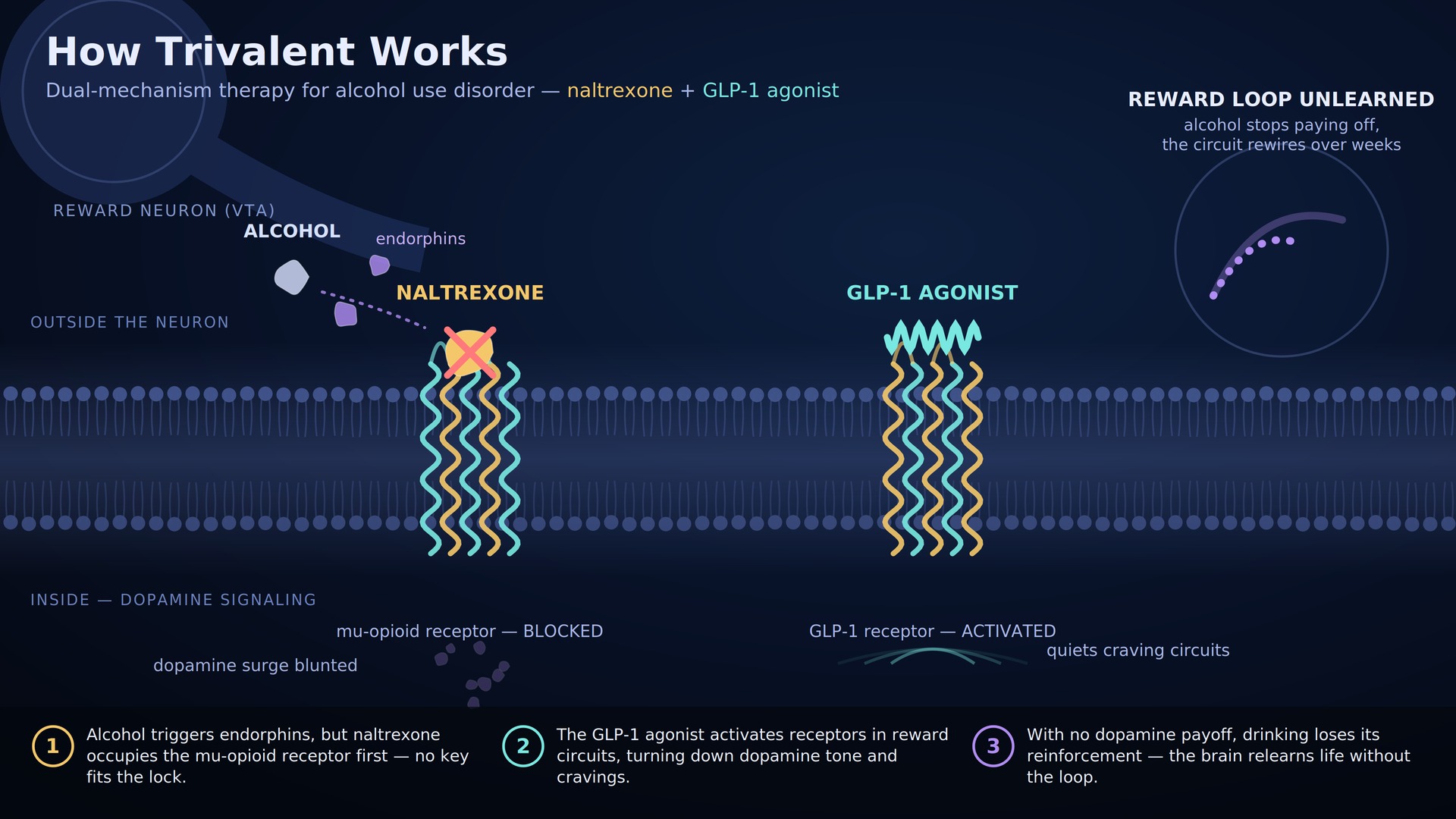
Naltrexone, an approved opioid antagonist, blunts the opioid-mediated reward of alcohol. Its efficacy in AUD is well established, and it is separately approved for opioid use disorder, where it blocks the effects of exogenous opioids after detoxification.
GLP-1-class agonists show growing evidence of reducing alcohol consumption. Multi-target incretins — tirzepatide (GLP-1/GIP) and glucagon-receptor-active co-agonists — may contribute additional effects, which we hypothesize but have not tested for our specific combinations.
Applications on file. Nothing granted.
We hold a provisional application (No. 64/110,198, filed July 13, 2026) and an earlier pending nonprovisional application (No. 19/705,839). No patent has been granted. A provisional secures a priority date only; whether any claims will ever issue, and how broadly, is uncertain and subject to examination. These are method-of-use applications covering combinations that use other companies' molecules. Alongside the Alcohol Use Disorder claims, the filings include method claims directed to opioid use disorder — pairing an incretin agonist with naltrexone for relapse prevention after medically supervised withdrawal.
The provisional broadens the position to a glucagon-receptor-active incretin co-agonist class (e.g., retatrutide, pemvidutide) combined with an opioid antagonist, and adds a lead embodiment pairing the FDA-approved agent tirzepatide with naltrexone.
We describe this space accurately, including where others are ahead of us. The programs below are in Alcohol Use Disorder, the more developed of the two indications.
| Program / reference | What it is | Status in AUD |
|---|---|---|
| Eli Lilly — brenipatide (LY3537031) | GLP-1/GIP agonist | Phase 3 AUD trials (RENEW-ALC-1/2) |
| Altimmune — pemvidutide | GLP-1/glucagon (GCGR) agonist | Phase 2 AUD (RECLAIM); FDA Fast Track |
| Semaglutide (GLP-1) | GLP-1 agonist | Human AUD signals; EHR evidence |
| US 2015/0038417 A1 (Novo Nordisk) | Prior-art application | Withdrawn; published disclosure covers GLP-1 agonist + naltrexone for alcoholism |
| Trivalent (this company) | Incretin (incl. tirzepatide / glucagon co-agonists) + naltrexone method | Provisional filed (2026) + pending application; concept stage; no data |
We are seeking a development or licensing partner for this combination IP — Alcohol Use Disorder, with opioid use disorder as an adjacent, investigational indication.
Trivalent's intellectual property is a method-of-use position; the Company is not a clinical developer. We are open to option, license, or research-collaboration discussions with pharmaceutical companies and specialty-pharma or IP groups positioned to develop or clear the combination — most naturally parties already working with incretin agonists in metabolic disease or addiction, or with naltrexone in opioid use disorder.
Download the non-confidential summary (PDF)
Partnership & licensing inquiries: contact@trivalent-therapeutics-inc.com

For scientific, partnership, or general inquiries, contact:
Business Development
Trivalent Therapeutics Inc., 8 The Green, Suite A, Dover, DE 19901